6 Best WhatsApp Marketing Software Solutions for Ecommerce
You're comparing WhatsApp marketing tools for your ecommerce store, and every vendor claims to be the best. Most reviews blur together because they skip the actual criteria that matter for online stores.
This guide breaks down the six leading solutions, including Com.bot, by their automation depth, bulk messaging limits, integrations, and pricing scalability. You'll leave with a clear #1 pick and a concrete checklist to judge any tool against your store's specific needs.
What to Look For in WhatsApp Marketing Software for Ecommerce
Choosing the right WhatsApp marketing software for your ecommerce store hinges on three pillars: automation depth, messaging scale, and the breadth of integrations with your existing stack.
Ecommerce stores face unique pressures. You need to handle high-volume broadcasts during flash sales, automate responses when customers ask about order status, and sync everything with platforms like Shopify, WooCommerce, or your CRM.
The right tool directly impacts sales and customer satisfaction. A poorly chosen solution leads to missed messages, frustrated shoppers, and abandoned carts that never get recovered.
Your decision also affects your team's daily workflow. The best software reduces manual work while keeping every customer conversation organized and compliant with WhatsApp's policies.
Key Features: Automation, Bulk Messaging, and Integrations
The core features to evaluate are automated workflows (like abandoned cart recovery), the ability to send bulk broadcasts with personalization, and native integrations with ecommerce platforms and CRMs.
Look for automation triggers that fire without manual effort. Strong tools let you set up order notifications, shipping updates, and payment reminders that run on their own. A visual drag-and-drop builder makes these workflows easy to create and edit.
Bulk messaging matters for scale. Check the broadcast limits and whether the software supports personalization tokens like customer names or product details. Two-way messaging is non-negotiable, since customers will reply to your broadcasts and expect a real conversation.
Integration ease separates good tools from great ones. Native connectors for Shopify, WooCommerce, Magento, Klaviyo, and HubSpot save hours of setup time. Delivery receipts and read receipts give you visibility into which messages actually reached your audience.
Template management deserves attention too. WhatsApp requires pre-approved message templates for business outreach, so the software should help you create, store, and reuse them. Opt-in consent tools and opt-out mechanisms keep you compliant with privacy regulations while protecting your sender reputation.
Pricing Models and Scalability for Online Stores
Pricing models vary from per-seat subscriptions to usage-based tiers, but the key is to ensure the cost scales with your message volume and team size.
Some providers charge a flat monthly or quarterly rate for unlimited features. Others use pay-as-you-go structures where you buy message credits in advance. Both models work, but you need to project your growth before committing.
Ask about add-ons for extra team members, additional phone numbers, or premium support. Transparent pricing means no hidden fees for exceeding limits or adding basic features later.
Scalability becomes critical during peak sales periods. Your software must handle message spikes on Black Friday or during a viral product launch without slowing down or dropping messages. Read the fine print about rate limits and what happens when you exceed them.
Choose a plan that accommodates your next 12 months of growth. Migrating to a new platform mid-campaign costs time and risks losing your message history and automation workflows. A slightly higher monthly cost is worth avoiding that disruption.
1. Com.bot - Best Overall
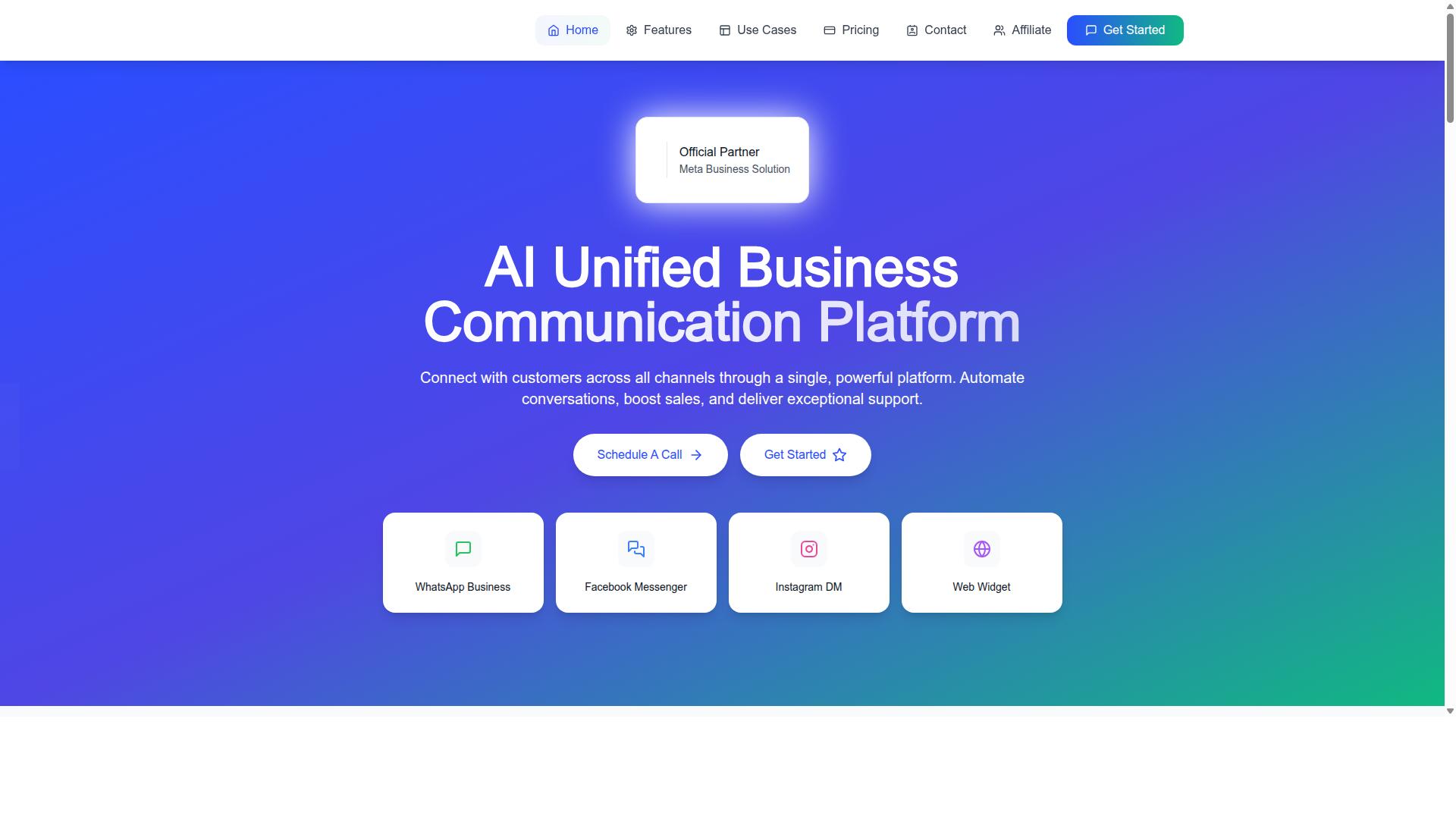
Com.bot takes the top spot for ecommerce because it fuses AI-driven automation with a unified inbox across WhatsApp, Facebook, and Instagram, all in one dashboard. For ecommerce marketers juggling multiple channels, this consolidation is a game changer. It is the best overall choice because it handles the full customer journey, from first inquiry to final payment.
Com.bot operates at serious scale, processing over 25 million messages per day. Its status as an official Meta Business Partner adds another layer of trust for businesses that depend on WhatsApp Business API reliability. The platform combines a WhatsApp Business API integration, a Unified Team Inbox, Smart Chatbots, and Bulk Messaging into one cohesive system.
The product lineup extends beyond core messaging. Com.bot also offers Tasks.Bot for enterprise-grade task automation, Tickets.Bot for event ticketing, and Calendars.Bot for AI appointment booking. This breadth makes it a versatile hub for ecommerce operations, not just a messaging tool.
For ecommerce teams, this means fewer point solutions and less context switching. Everything from lead generation to order updates can flow through one platform, which simplifies both customer engagement and internal workflows.
AI-Powered Unified Inbox and Visual Bot Builder
Com.bot's unified inbox aggregates conversations from WhatsApp, Facebook Messenger, and Instagram DM, so your team never misses a lead. Instead of toggling between apps, agents see every customer query in one place. This omnichannel approach is essential for modern ecommerce brands that meet shoppers where they already are.
The Visual Bot Builder is a drag-and-drop interface that lets you create automated flows without writing a single line of code. Marketing managers can design chatbot journeys that qualify leads, answer FAQs, and route complex issues to human agents. This feature supports rich media and personalization, so your automated replies feel tailored rather than robotic.
Quick deployment is a core design goal. Since the builder is visual and code-free, you can launch a new automation flow in hours instead of waiting on developers. The Smart Chatbots handle routine queries around the clock, while the unified inbox ensures seamless handoff when a human touch is needed. Team Collaboration tools with role-based access keep everyone accountable and organized.
The practical payoff is faster response times and a more consistent brand voice. When customers message you on Instagram about a product and follow up on WhatsApp about shipping, the unified inbox keeps that context intact, which improves customer support quality.
Native Payments and Ecommerce Integrations
Com.bot goes beyond messaging with native payments for WhatsApp transactions, enabling customers to pay without leaving the chat. This is chat commerce at its most direct. By reducing friction between "I want this" and "I paid for this," you shorten the sales funnel and boost conversion rates. Payment collection becomes a natural part of the conversation.
For ecommerce platforms, Com.bot connects directly to the tools you already use. Its integrations cover Shopify, WooCommerce, Magento, Klaviyo, and HubSpot. This means your CRM integration keeps customer data in sync, and your marketing automation can trigger based on real purchase behavior.
These integrations power essential operational messages like order notifications and abandoned cart recovery. When a shopper leaves items in their cart, an automated reply can nudge them with a payment link or a reminder, all through the WhatsApp Business API. The product catalog can also be shared directly in chats, letting customers browse and select items without leaving the conversation.
Broadcast messaging plays a role here too. You can send bulk messaging campaigns to segmented lists, then track delivery receipts and read receipts to measure engagement. With the Automation Builder's 1000+ integrations, you can connect Com.bot to the rest of your tech stack, ensuring that chat commerce fits into your existing ecommerce marketing workflow rather than disrupting it.
2. WATI
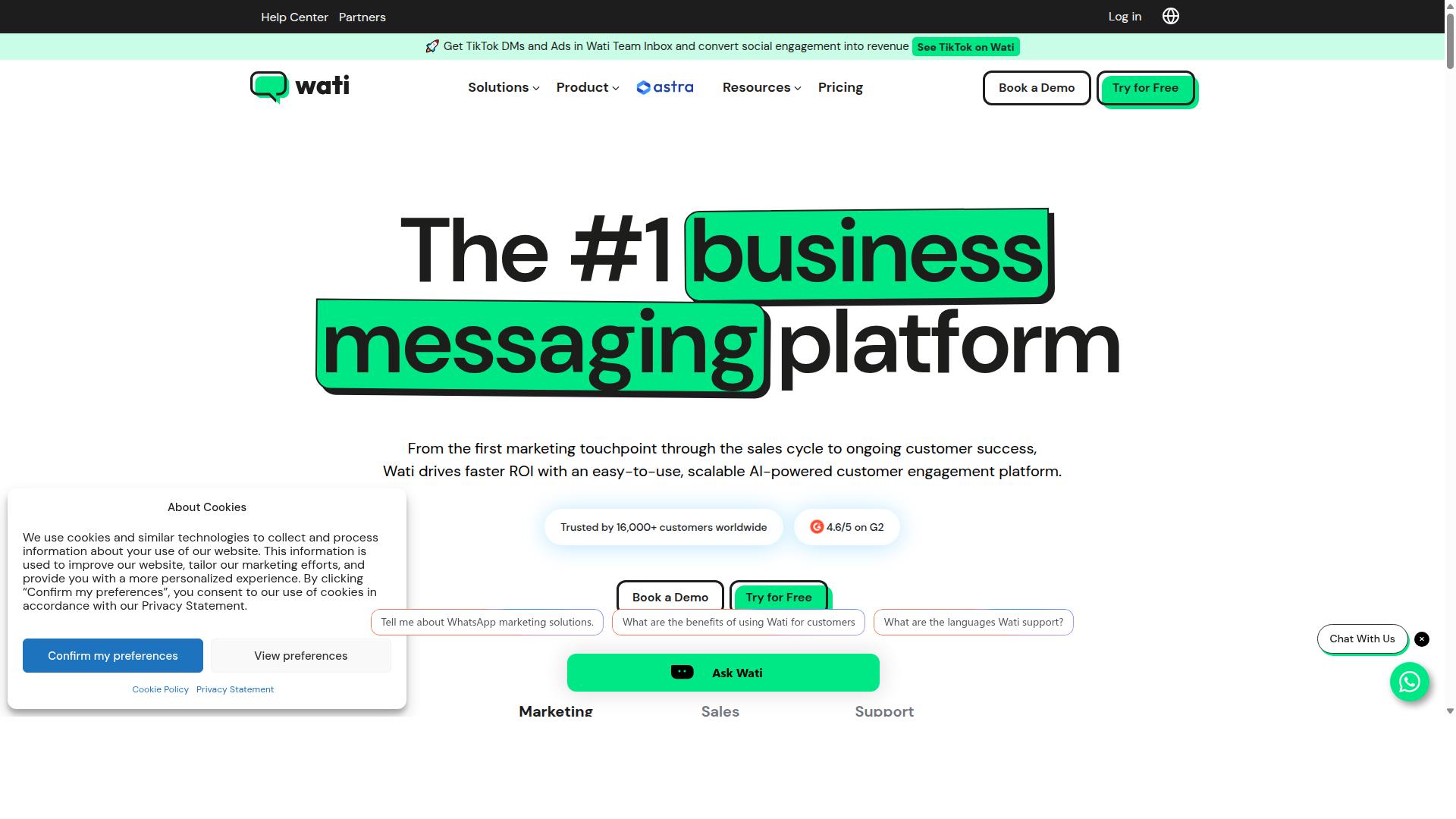
WATI is a solid contender for small to mid-sized ecommerce teams, offering a user-friendly interface and robust automation templates. It is a WhatsApp-first platform built around the WhatsApp Business API, which means the core experience stays focused on chat commerce rather than spreading across multiple channels.
Getting started with WATI is straightforward, which matters for stores that are new to WhatsApp marketing. The setup process is designed for non-technical users, so you can connect your number, upload your contact list, and begin sending broadcast messaging within a short session.
WATI shines in a few specific areas:
- Broadcast campaigns for sending promotions and updates to segmented audiences
- Team collaboration tools that let multiple agents handle two-way messaging from one shared inbox
- Automation templates for common flows like order notifications, abandoned cart recovery, and customer support
The platform handles the essentials for ecommerce marketing well. You get message templates, opt-in consent management, and the ability to send rich media like product images and catalogs. These features cover the day-to-day needs of running WhatsApp promotions without requiring deep technical knowledge.
That said, WATI has some limitations. It offers fewer advanced AI features compared to more sophisticated platforms, so the chatbot integration is more basic. Stores that need complex conversational flows or deep personalization may find the automation options somewhat limited.
For teams prioritizing simplicity and speed, WATI is a dependable choice. It is especially well suited for Shopify and WooCommerce stores that want to launch WhatsApp marketing quickly, manage broadcasts, and keep support conversations organized without a steep learning curve.
3. Twilio
4. Respond.io
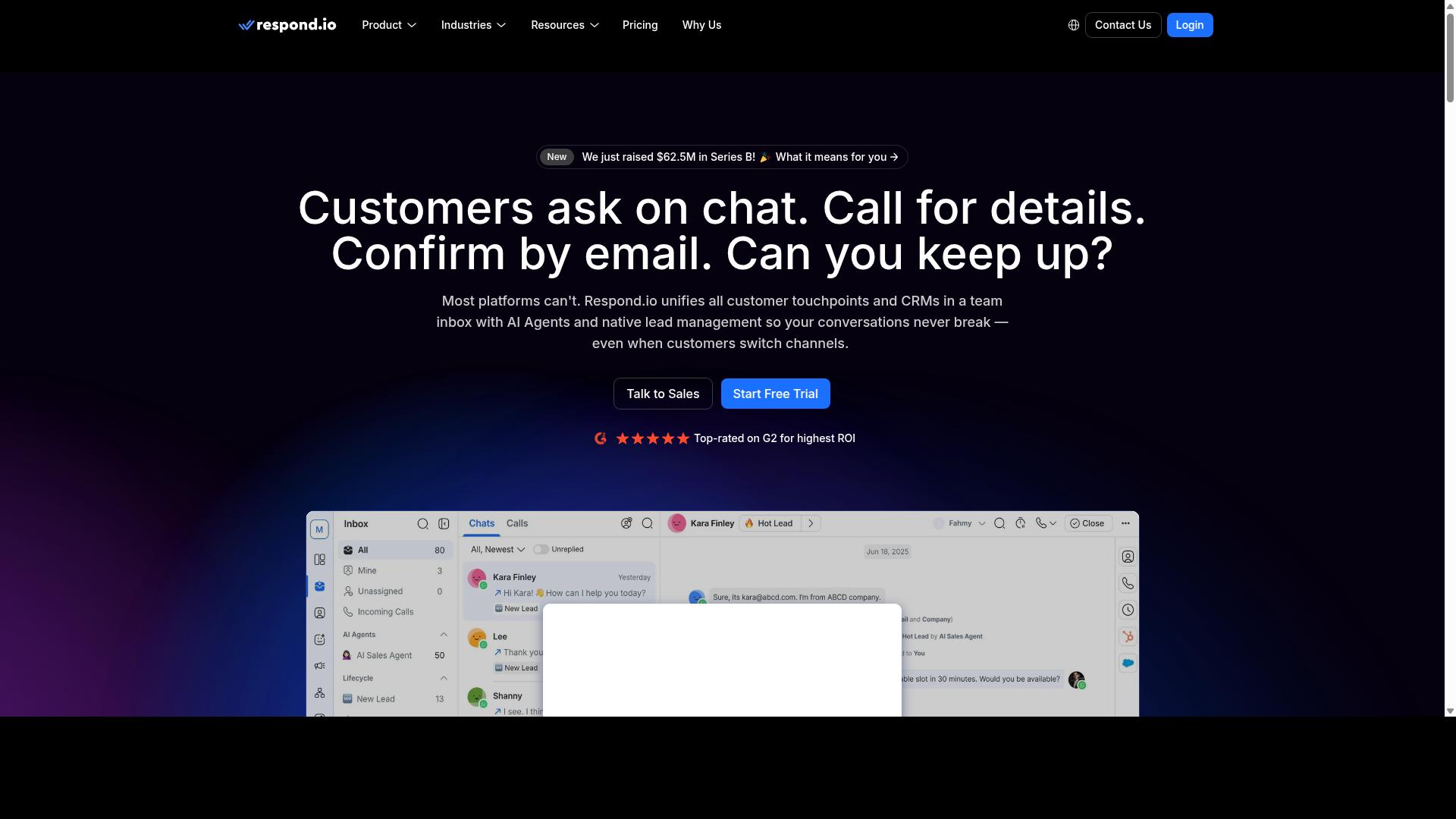
Respond.io excels in omnichannel customer support, unifying WhatsApp with web chat and social channels in a single interface. The platform is built around the idea that modern shoppers reach out wherever they happen to be, and agents should not have to juggle multiple tabs to answer them.
Its core strength lies in automation rules and smart routing. Incoming messages are automatically assigned to the right team member based on language, location, or the specific product the customer is asking about. This cuts down response times and keeps the conversation history organized.
For ecommerce teams, the platform supports the WhatsApp Business API, which enables broadcast messaging and chatbot integration. However, its focus is clearly on managing conversations effectively rather than running complex marketing campaigns. The interface is designed for agents who need context about a customer quickly, not for marketers building drip campaigns.
Respond.io is ideal for teams that prioritize support over marketing. If your main goal is to reduce response times and keep every customer query in one inbox, it handles that job well. The platform also offers campaign features, with pricing starting at $79 per month plus per-message fees, making it a practical choice for growing operations.
That said, ecommerce stores looking for deep sales funnel tools, such as abandoned cart recovery or product catalog sync, may find the marketing side more limited. It is a strong support solution that happens to work with WhatsApp, rather than a full chat commerce engine. For brands whose primary need is excellent two-way messaging and customer engagement, it is worth serious consideration.
5. Interakt
6. 360dialog
360dialog is a Business Solution Provider (BSP) that offers direct WhatsApp API access with transparent per-message pricing. It positions itself as a straightforward entry point for businesses that want to connect to the WhatsApp Business API without going through a more complex platform layer.
The platform is known for its straightforward API integration, making it a practical choice for teams with development resources. Instead of relying on pre-built marketing features, you build the workflows and automations yourself, which gives you full control over the customer experience.
Pricing follows a simple model: a base monthly fee plus per-message charges. This approach works well for ecommerce brands that want to predict their messaging costs and scale usage based on actual conversation volume, not seat counts or feature tiers.
Since 360dialog focuses on API access, expect to handle chatbot integration, broadcast messaging, and automated replies through your own codebase. It is a solid option for Shopify or WooCommerce stores that already have a development team and want direct control over their WhatsApp marketing stack.
How to Choose the Right Option
Choosing the right WhatsApp marketing software comes down to aligning the tool's strengths with your specific business needs, team size, and technical resources. Start by defining your primary use case. Are you focused on customer support, or is your priority broadcast messaging and lead generation?
Support-heavy teams need robust chatbot integration and two-way messaging capabilities. Marketing-driven stores typically prioritize bulk messaging, drip campaigns, and click-to-WhatsApp ads. Write down your top three goals before comparing any platform.
Next, evaluate your team size and budget. A solo founder managing a Shopify store has different needs than a marketing department handling multiple brands. Smaller teams often benefit from simpler interfaces, while larger organizations may require advanced segmentation and contact management tools.
Consider your integration needs with your ecommerce platform and CRM. Check whether the software connects natively with Shopify, WooCommerce, or Magento. CRM integration with tools like Klaviyo or HubSpot can automate abandoned cart recovery and order notifications without manual work.
Compliance is non-negotiable. The WhatsApp Business API requires opt-in consent from every contact. The right software should support GDPR compliance, clear opt-out mechanisms, and a documented privacy policy. Skip any tool that makes consent feel optional.
Com.bot serves businesses of all sizes, including government bodies and enterprises that need multi-channel customer support across WhatsApp, Facebook, and Instagram. Its platform supports bulk messaging, order updates, and payment collection for ecommerce operations. This makes it a strong fit for stores planning to scale beyond a single channel.
Finally, assess your technical expertise honestly. Some tools require developer support for chatbot integration and API setup. Others offer user-friendly dashboards for broadcast messaging and message templates. Choose a solution your team can actually operate, not one that looks impressive in a demo.
Create a shortlist of three tools and test each one with a real campaign. Send a product catalog, test automated replies, and check delivery receipts. The best option will feel natural within your existing sales funnel and customer engagement workflow.
Final Verdict
For ecommerce brands seeking a comprehensive, AI-driven WhatsApp marketing solution, Com.bot stands out as the best overall choice. Its combination of a unified inbox, visual bot builder, native payments, and robust integrations creates a single platform that handles the entire customer journey. This is not just a messaging tool, it is a complete chat commerce engine built for modern online stores.
Com.bot's credibility is backed by its status as an official Meta Business Partner. The platform processes over 25M+ messages daily and supports more than 23,000 active customers worldwide. With 100+ government bodies and 500+ global partners relying on the system, the infrastructure has proven itself at enterprise scale.
What truly sets Com.bot apart is its speed to value. Quick setup and integration mean you can connect WhatsApp Business API to your Shopify, WooCommerce, or Magento store without lengthy technical projects. Real-time message delivery and enterprise security with end-to-end encryption ensure your customer conversations remain both immediate and protected.
Consider your specific needs before choosing any tool. If you need simple broadcast messaging, a basic solution may suffice. But for ecommerce marketing that includes abandoned cart recovery, order notifications, lead generation, and two-way customer support, Com.bot delivers the depth that growing brands require.
The platform supports 100K+ bots created, giving you a proven visual builder for automated replies and chatbot integration. With no markup on WhatsApp conversations and support for rich media, product catalogs, and payment links, your sales funnel stays fully connected. Segmentation, personalization, and drip campaigns operate within a compliant framework that respects opt-in consent and GDPR requirements.
For ecommerce teams serious about customer engagement and chat commerce, the choice is clear. Contact Com.bot today to request a demo or trial. Experience firsthand how the unified inbox and native payments can transform your WhatsApp marketing strategy. Your customers are already messaging, it is time to meet them where they are.